


A Historic Shift in Singapore’s Foreign Investment Landscape in 2025
In 2025, Singapore’s foreign investment landscape reached a historic turning point.
According to the Singapore Economic Development Board (EDB) Annual Report 2025, investment from China surged dramatically—
surpassing the United States in fixed asset investment (FAI) for the first time and becoming Singapore’s second-largest investment source after Europe.
This was not driven by a handful of large projects, but rather a broad-based, structural shift.
Explosive Growth of Chinese Investment
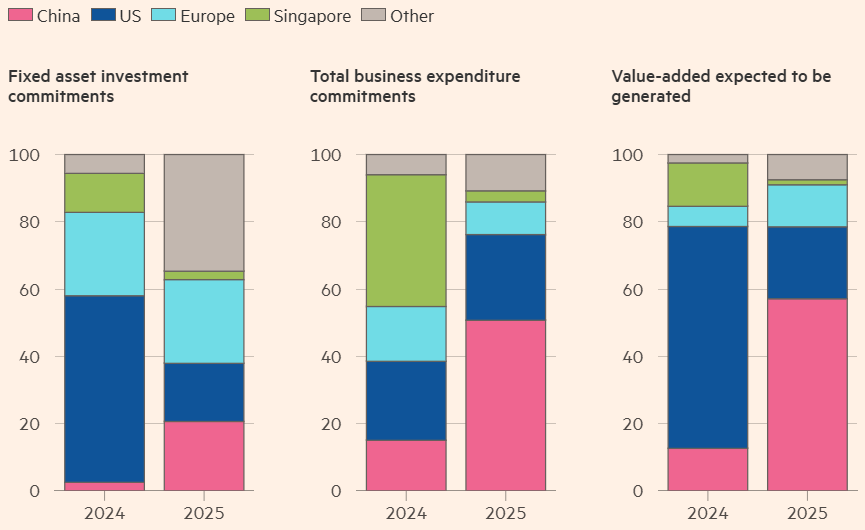
In 2025, Singapore attracted S$14.2 billion in fixed asset investment. The investment breakdown was as follows:
-
Europe: 24.9%
-
China: 20.6%
-
United States: 17.3%
By comparison, in 2024:
-
United States: 55.5%
-
China: only 2.5%
Within just one year, China’s share increased nearly eightfold, a change rarely seen in Singapore’s investment history.
In absolute terms:
-
China investment in 2024: S$340 million
-
China investment in 2025: S$2.93 billion
This also marked the first time since 2013—when EDB began reporting China as a separate source—that Chinese investment exceeded double-digit percentage share.
Beyond Capital: Real Economic Presence
Investment size alone does not tell the full story.
In two key indicators reflecting actual business operations, Chinese enterprises demonstrated even stronger presence:
-
Total Business Expenditure (TBE): 50.7%
-
Value Added contribution: 57.1%
This indicates that more than half of Singapore’s:
-
Salaries
-
Office rentals
-
Operational expenditures
-
Direct GDP contributions (wages + profits)
were generated by Chinese-invested companies.
In 2024, these figures stood at just:
-
TBE: 15%
-
Value Added: 12.6%
This is the first time in over a decade that both metrics exceeded 50%.
Why Are Chinese Companies Expanding Overseas Faster?
EDB Chairman Png Cheong Boon reaffirmed Singapore’s position:
Singapore remains an open economy.
We welcome all companies that comply with regulations and maintain substantive operations.
From the corporate perspective, the motivation is clear.
As China’s domestic growth moderates, overseas expansion has become a strategic necessity rather than an option:
-
Q4 2025 China GDP growth: 4.5% (lowest in three years)
-
Full-year growth: approximately 5%
-
More than half of provinces missed growth targets
-
Only 3 of the top 10 economic provinces recorded acceleration
Against this backdrop, Singapore’s stability, regulatory clarity, and global connectivity make it a natural gateway.
Rising Chinese Investment Does Not Mean “De-Westernization”
It is important to note that the rise of Chinese investment does not signal reduced engagement with Western economies.
EDB emphasized that:
-
The US and Europe remain the largest sources of investment commitments
-
Their positions remain strong in both existing and new investments
Amid global fragmentation and supply chain reconfiguration, Singapore’s role has become even clearer:
A reliable hub for multinational companies to
strengthen resilience and anchor their Asia-Pacific strategies.
A Clear Signal for 2026 and Beyond
The message from the data is unmistakable:
Singapore continues to be a critical internationalization platform for Chinese enterprises.
Not merely for incorporation, but for:
-
Regional headquarters
-
Substantive business operations
-
Talent deployment
-
Tax and compliance structuring
-
Long-term strategic positioning
For Chinese companies considering global expansion:
The question in 2026 is no longer “whether to consider Singapore,”
but “how to enter earlier and more effectively.”
Reference
- 联合早报
https://www.zaobao.com.sg/finance/singapore/story20260209-8355788
- Financial Times
https://www.ft.com/content/f5b2d154-ab8c-40f2-a148-e0022b1d5349?utm_source=chatgpt.com

