As tax season approaches, many individuals living and working in Singapore ask the same questions: As a Singapore tax resident, do I need to file a tax return, how is tax calculated, and what should I watch out for during the filing process? This article is intended only for Singapore tax residents and summarises the key points relevant to personal income tax filing for 2026. Before filing, an individual should first confirm whether he or she qualifies as a tax resident under IRAS rules.
1. When is the 2026 personal income tax filing season?
According to IRAS, the 2026 tax filing season runs from 1 March 2026 to 18 April 2026. Tax residents who are required to file should submit their individual income tax return through myTax Portal within this period.
2. Do all tax residents need to file?
Not every tax resident has to actively submit a return. However, IRAS states that generally, an individual is required to submit an Income Tax Return if his or her total income in the preceding calendar year exceeds S$22,000. In addition, individuals who receive a filing notification from IRAS are expected to comply with the filing requirement.
It is important to distinguish between two concepts that are often confused. S$22,000 is commonly used as the general threshold for determining whether an individual typically needs to file a tax return. By contrast, S$20,000 is not a filing threshold; it refers to the first band of chargeable income that is taxed at 0% under the resident tax rate table.
Some tax residents may also fall under the No-Filing Service (NFS) or receive a direct tax bill. Where IRAS has informed an individual that he or she is under NFS, a separate filing is generally not required unless there is a need to amend income details or relief information.
3. What are the resident tax rates in Singapore?
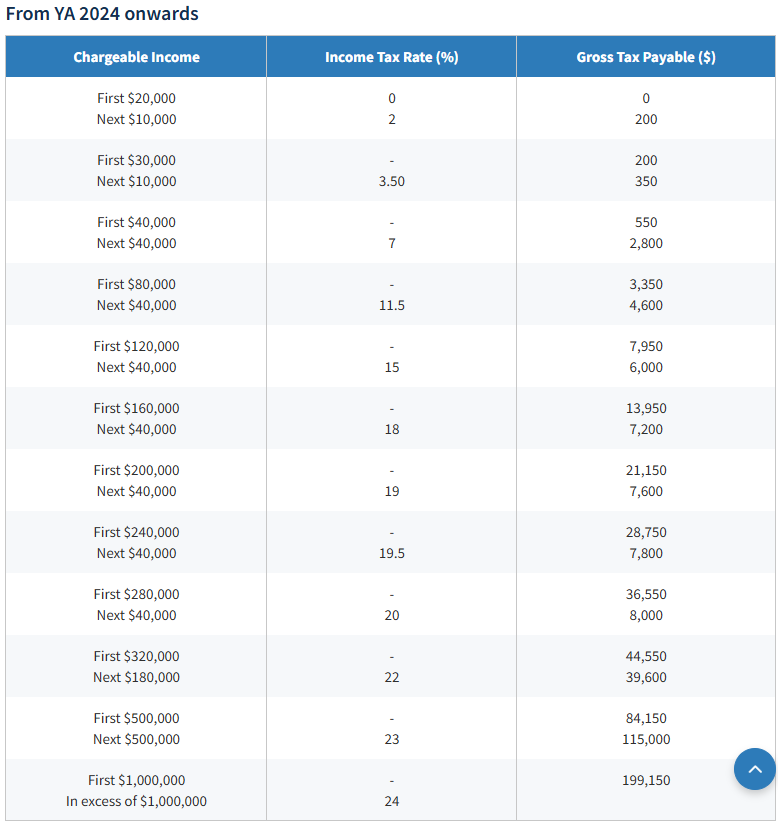
For Singapore tax residents, personal income tax is charged on a progressive basis, with rates ranging from 0% to 24%. The first S$20,000 of chargeable income is taxed at 0%, and the rate increases progressively as chargeable income rises. The current top marginal resident rate is 24%.
It is equally important to note that the resident tax rate table applies to chargeable income, not total income. In practical terms, the final tax payable is not calculated simply on gross annual income, but on the applicable chargeable income after relevant deductions, donations and personal reliefs have been taken into account.
In broad terms, the current resident tax structure applies 0% on the first S$20,000 of chargeable income, followed by 2% on the next S$10,000, 3.5% on the next S$10,000, then 7%, 11.5%, 15%, 18%, 19%, 19.5% and 20% across successive bands, with income above S$320,000 taxed at 24%.